Showing posts with label hyundai. Show all posts

Sunday, March 16, 2014

Hyundai Genesis Coupe


  •  Hyundai Genesis Coupe, 2013

The Hyundai Motor America introduced the significantly redesigned 2013 Hyundai Genesis Coupe in a North American debut at the 2012 Detroit North American International Auto Show. In keeping with impressive performance upgrades, Genesis Coupe now sports more aggressive coupe styling, complemented by improved interior materials and design. Both 4-cylinder and V6 engines benefit from significant technology enhancements, with the 3.8-liter V6 engine receiving sophisticated direct-injection technology and the 2.0-liter turbocharged engine upgrading to a more precise twin-scroll turbocharger and larger intercooler. Automatic transmissions for these two models now have 8-speeds, with paddle-shift SHIFTRONIC manual-shifting capability. Hyundais proprietary telematics platform, Blue Link, is now available, providing Hyundai Genesis Coupe owners with a variety of infotainment services to meet their individual connectivity needs.

AGGRESSIVE DESIGN CUES MATCH ENHANCED DYNAMIC PERFORMANCE
The reshed Hyundai Genesis Coupe strikes a more menacing demeanor, with an aggressively redesigned front fascia, grille, headlights, LED daytime running lights, fog lights and hood with heat extractor cues. The side view reveals new, aggressive 18- and 19-inch alloy wheel designs with deeper dimensional sculpting. Finally, the rear taillights provide a visual spark via premium LED illumination and new contours. Of course, the traditional rear-drive sport coupe proportions remain, with a long wheelbase and short front and rear overhangs producing a classic wedge-like profile. Genesis Coupes bodyside character line is an innovative "Z"-shaped design that integrates seamlessly with a unique, drop-beltline rear window graphic.

Genesis Coupes arching roofline and tapering greenhouse highlight the exterior profile and emphasize the cars broad shoulders and wide stance. To complete the aggressive sports car look, the depth between the fenders and the greenhouse has been maximized.

Enlarged openings in the front fascia allow for better engine breathing along with a more aggressive look. Dual asymmetrical exhaust tips integrated with the blackout rear diffuser treatment complete the performance message from the rear.

POWERTRAIN ENHANCEMENTS
Both Hyundai Genesis Coupe engines receive significant technology upgrades, backing up its new design statement with impressive performance gains. The 3.8-liter Lambda DOHC V6 engine adds sophisticated direct-injection technology, adding 42 horsepower (a generous 14 percent increase) and 29 lb.-ft of torque (an eleven percent increase). Peak horsepower rises to 348 at 6,400 RPM, with peak torque increasing to 295 lb.-ft. at 5,300 RPM on premium fuel. In addition, lambda-engine anti-knock technology gives this V6 the versatility to run on regular fuel. This new direct-injected engine will easily propel the Genesis Coupe from zero to 60 mph in the lower five-second range on its way to an impressive 149 mph electronically-limited top speed. The Lambda V6 intake system also now employs an intake sound induction pipe into the cabin to ensure this engines aural character matches its visceral appeal.

To further broaden the power band, the 3.8-liter engine uses Dual Continuously Variable Valve Timing (Dual CVVT) and a Variable Intake System (VIS) that helps cylinders breathe most efficiently at both low and high RPM. The combination of high-pressure, precisely-metered direct injection with efficient cylinder breathing results in outstanding throttle response and off-the-line acceleration coupled with remarkable fuel efficiency. The V6 engine uses an alloy block and cylinder heads for lighter weight and thermal efficiency and features durable, quiet timing chains with no scheduled maintenance.

All these technologies serve to give Hyundai Genesis Coupe 3.8 an impressive power-to-weight ratio of only 10.0:1; significantly lower than the more expensive Infiniti G37 and BMW 335i.

Not to be outdone by its bigger brother, the turbocharged, intercooled 2.0-liter DOHC inline four-cylinder substitutes a new twin-scroll design for its turbocharger in addition to a larger intercooler with enhanced thermal efficiency. The twin-scroll design is more efficient at recovering exhaust energy and produces cooler cylinder temperatures than the former single-scroll design. In addition, the twin-scroll is more precise, with improved combustion efficiency, reduced turbo lag, leaner air/fuel ratios and more evenly distributed pressure in the exhaust ports, resulting in simultaneous power, efficiency and emissions improvements. Also, a 53 percent larger intercooler further reduces intake temperatures, providing denser, cooler air from which to develop even more power.

The turbocharged engine also benefits from Dual CVVT on both intake and exhaust camshafts. The 2.0-liter turbo now generates 274 horsepower (a massive 30 percent increase) and 275 lb.-ft. of torque (an impressive 23 percent increase) on premium fuel. And, unlike many competitive turbo engines, this turbos anti-knock sensors automatically adjust ignition timing and engine mapping to run perfectly on regular fuel, yielding 260 horsepower at 6,000 RPM and 260 lb.-ft. of torque at 2,000 RPM. The turbo engine also features a cast-aluminum cylinder block and cylinder head. All these improvements give the Genesis Coupe 2.0T a power-to-weight ratio of 12.3, superior to the upcoming Scion FR-S sports coupe and the Honda Civic Si.

Both V6 and 4-cylinder engines also feature deeper, baritone-sounding dual cat-back exhausts to complement more efficient breathing on the intake side. To ensure that all this new power is evenly distributed to the pavement, Hyundai Genesis Coupe also offers an available Torsen limited-slip differential on R-Spec and Track models.

REAR-WHEEL-DRIVE ARCHITECTURE
Genesis Coupes body shell makes generous use of ultra-high-tensile steel. The rear-wheel drive powertrain configuration provides a well-balanced 55:45 front-to-rear weight distribution for the 2.0T, and 56:44 for the 3.8 model.

SPORT-TUNED SUSPENSION
No well-tuned sport coupe chassis should give the perception of being overwhelmed by its powertrain, and Genesis Coupe is no exception to this rule. Spring, damper, and bushing ratings all have been precisely recalibrated to match these new powertrains with better road feel, more precise body motion control and improved ride comfort.

Hyundai Genesis Coupe employs a MacPherson strut dual-link front suspension and a five-link rear suspension setup. The front suspension is mounted to the body via a solid subframe that is lighter and stronger than a comparable multi-piece component would be. To help reduce body roll and tune the Genesis Coupes at-the-limit handling for maximum predictability, 23-mm diameter front and 19-mm diameter rear stabilizer bars are fitted.

While all Genesis Coupe models offer a true rear-drive sport driving experience, the high-performance Hyundai Genesis Coupe R-Spec and Track models raise the bar even higher with differentiated, track-tuned suspension calibrations. The R-Spec/Track suspension features both firmer front spring rates (seven percent) and rear spring rates (eleven percent), with matched damper rates. The Genesis Coupe R-Spec/Track models also deliver a significant increase in roll control over other versions of the Genesis Coupe via thicker stabilizer bars (24mm front/20mm rear). For 2013, all Hyundai Genesis Coupes receive improved low-velocity-control dampers for ined ride comfort coupled with improved body control.

In addition, all R-Spec and Track models now receive front strut camber adjustment bolts that can be easily installed in the front strut assembly at their owners discretion. These camber adjustment bolts allow approximately -1.5 degrees of negative front camber adjustment for sharper, more responsive apex turn-in and significant understeer reduction in competitive events.

Of course, superb Genesis Coupe structural rigidity sets the fundamental foundation for dynamic precision, regardless of specific suspension calibration.

STEERING
Hydraulic, RPM-sensing rack-and-pinion steering has been recalibrated with an even quicker, 13.8:1 ratio, delivering both linear feel and agile response to driver inputs. This new steering ratio is a full seven-percent quicker than the previous model, yielding intuitive steering response and precision. To further optimize driver ergonomics, telescopic adjustment also has been added to tilt adjustment for 2013.

TRANSMISSIONS
Both engines are mated to standard six-speed manual transmissions which have been extensively ined to provide more driver-friendly shift gating and balanced weighting precision. The clutch take-up, feel, and engagement characteristics also have been ined for optimum shifting ease and feel. Both engines now offer an in-house-developed eight-speed automatic with paddle-shift SHIFTRONIC manual-shifting capability. Each transmission has been specifically tuned to match its engines unique power and torque curve characteristics.

In addition to the steering wheel-mounted paddle shifters, each automatic offers shift capability via the shift lever according to individual driver perence. A clear LCD readout on the instrument panel shows the selected gear at all times.

HIGH PERFORMANCE BRAKING SYSTEMS
Brembo four-piston calipers clamp down on fade-resistant 13.4-inch ventilated front brake rotors and 13-inch ventilated rear rotors on both R-Spec and Track models. All other models get substantial 12.6-inch front ventilated rotors and 12.4-inch rotors in the rear with floating single-piston calipers.

UPSCALE INTERIOR REFINEMENT
The 2013 Genesis Coupe interior has been enhanced with distinctive, upscale features and design cues. The instrument panel crash pad features a stitched-seam appearance for a distinctly upscale look, and the parking brake lever is leather-wrapped on leather-equipped models. The instrument cluster now features an electroluminescent gauge cluster for premium ambience and superior readability. A new driver-side rear seat walk-in assist function has been added for more convenient rear seat access from the drivers side. Convenient seatbelt assist guides make it easier for front passengers to buckle up.

In addition, driver seat power lumbar support is now available and front seatback pockets are standard on all Genesis Coupes. A center stack multi-gauge cluster with instantaneous mpg, torque level (3.8 models) or turbocharger boost pressure (2.0T models), and oil temperature is standard on all trims. A center fascia tray with cover has been added for enhanced storage, and interior surfaces now have a softer touch with lower sheen for a more up-market feel. Sport front seats with deep side bolsters offer superb lateral support for enthusiastic driving in all trim configurations.

Among other premium features are an available Infinity premium audio system and two-stage front seat heaters. Hyundai Genesis Coupe also offers the convenience of a Proximity Key and push-button start.

INNOVATIVE TECHNOLOGIES
Genesis Coupe offers Xenon high-intensity discharge (HID) headlights, for brighter illumination intensity, more daylight-like lighting character and reduced power consumption. In addition, the visual cut lines of these HID headlights are razor sharp, providing maximum nighttime visibility to the driver without the risk of blinding oncoming traffic.

Music lovers will welcome the Genesis Coupes standard auxiliary input jacks (3.5 mm mini-jack and USB input) to accommodate and charge personal audio devices such as an iPod®. When an iPod or flash drive is connected through the USB port in the center storage compartment, not only does it play music through the vehicles audio system, but it also charges the iPod and allows the driver to access tracks with the steering wheel audio controls. This system also allows both driver and passengers to easily view song/artist/title information and control the music from the audio head unit rather than the iPod unit. This safety-oriented function allows the driver to keep his or her focus on the road at all times.

HYUNDAI BLUE LINK
Hyundai Blue Link telematics is available on 2013 Genesis Coupe with a 90-day complimentary trial period. The Blue Link platform is available on 3.8 Grand Touring/Track and 2.0T Premium trim levels. Blue Link can be accessed from the buttons on the rearview mirror inside the Hyundai Genesis Coupe, the web and via smart phone. Blue Link is offered in three telematics service packages: Assurance, Essentials and Guidance.

SEGMENT-LEADING STANDARD SAFETY TECHNOLOGIES
In keeping with Hyundais focus on offering segment-leading standard safety technologies across its lineup, the 2013 Genesis Coupe includes a wide range of both active and passive safety features. Standard safety technology includes driver and front passenger advanced frontal airbags, along with front seat-mounted side airbags, side air curtains and active front head restraints.

Genesis Coupe has strong unibody construction, along with front and rear crumple zones, bodyside reinforcements and five-mph energy-absorbing bumpers. The hood also includes buckling creases and safety stops.

The front seatbelts have pretensioners and force limiters, and the rear seats feature LATCH (Lower Anchors and Tethers for Children), which make affixing child safety seats easier.

All Hyundai Genesis Coupe models feature standard four-channel ABS with Electronic Brake-force Distribution (EBD) to optimize brake performance under various dynamic loading conditions. The system also includes Brake Assist, which provides maximum ABS-level braking force when a panic stop is detected.

Electronic Stability Control (ESC), one of the industrys most effective life-saving technologies, is standard in all Genesis Coupe models. Insurance Institute for Highway Safety (IIHS) studies suggest vehicles equipped with ESC experience 56 percent fewer fatalities in single-vehicle crashes than those without it.

In a nod to enthusiasts, 2013 Genesis Coupe now offers a specially-tuned three-stage driver-selectable ESC mode. This new three-stage ESC function offers more options for various driver perences and road conditions:
  • Full-on ESC function (default mode on start-up)
  • Intermediate ESC function with driver powertrain override control and retained ESC/TCS braking function
  • Full-off ESC function for uninhibited driver vehicle control in all conditions

The driver-selectable full-off ESC mode has been calibrated to provide drivers with a larger performance envelope should they choose to participate in competitive events such as autocrosses or track days. The Hyundai Genesis Coupe anti-lock braking system function (ABS) remains fully functional in all ESC modes to help drivers maintain steering control under adverse braking conditions.

COLOR PALETTE
With Genesis Coupes more aggressive exterior design cues, fresh exterior color offerings are now available, with seven new colors added to the palette. In keeping with Hyundai Genesis Coupe color names selected at launch, all new color names are derived from world-famous racing circuits and their most challenging track segments. These new colors include: Parabolica Blue, Catalunya Copper, Monaco White, Becketts Black, Circuit Silver, Gran Premio Gray, and Shoreline Drive Blue.

To further complement Hyundai Genesis Coupes freshened interior design and premium materials, a new tan leather interior, a new red leather bolster/red cloth insert interior, and a new gray leather bolster/gray cloth insert interior have been added to the interior color environment selections.

Friday, March 14, 2014

Hyundai RE Mix

For the second year in a row, Hyundai is staging music events around the country to showcase a customized Elantra, Genesis, and Veloster Turbo. Called the RE:Mix Lab, it started in Chicago, traveled to New York City, and is now headed to Austin, Las Vegas, Los Angeles, Seattle, and finally, Miami in early December. Upon arrival to the event, you sign into the app in via Facebook and are given a bracelet to interact with the art and fashion displays surrounding the cars while waiting for local bands to perform.

The 2013 Elantra GT was fitted with a cargo roof rack and painted a light matte green. Recycled tweed fabric covered the seats and accented the the interior. Granola doesnt have to be boring, though, and completing the glamping concept was a Nintendo Wii with a 15-inch motorized TV in the back.

The pearly white 2013 Genesis Coupe 2.0T R-Spec looked gorgeous with a poppy-red suede-like interior, racing seats and carbon fiber accents. The Genesis was the only car of the three to get a performance upgrade with and intake and exhaust. Not to be left out of the audio upgrades, an audio system was added with a subwoofer box and custom speaker pods.

Finally, the Veloster Turbo was shiny! with an all-chrome exterior and Lux headlamps. Inside, the Rockford Fosgate glowed with neon orange accents. For all of your dj-ing needs,
an interactive touchscreen DJ station with mixing software and three subwoofers was fitted into the back. The mobile clubbing experience is rounded out with inside strobes.

If youre in any of the listed cities, check out the Hyundai RE:Mix Lab by simply liking the page on Facebook.

Related posts:

  1. Hyundai to show new rear wheel drive coupe concept at LA auto show
  2. Driven: Hyundai Genesis Coupe 3.8 Grand Touring
  3. Review: 2013 Hyundai Genesis Coupe
  4. 2009 Hyundai Genesis: Quiet comfort on the race track
  5. Hyundai Adds Genesis 5.0 R-Spec Sedan


Monday, March 3, 2014

Hyundai Santa Fe Sport


  •  Hyundai Santa Fe Sport, 2013

The all-new third-generation Hyundai Santa Fe launches in two flavors, a five-passenger model similar in size to the previous generation Santa Fe, and a longer wheelbase three-row, seven-passenger model. Both are capable crossovers built for todays family, with flexible seating and cargo, strong performance courtesy of dramatic weight savings (266 lbs. lighter than the 2012 model) and advanced safety technologies. Santa Fe showcases the brands cutting-edge capabilities through its bold design, impressive fuel economy and a host of features to delight drivers and passengers with high expectations for functionality and comfort. The all-new 2013 five-passenger Hyundai Santa Fe Sport began arriving at dealerships in August 2012, with the long wheelbase Santa Fe set to arrive in January 2013.

NO LINES STANDING STILL
The "Fluidic Sculpture" exterior of the Santa Fe crossover family invokes the impression of irrepressible motion through a new design concept called Storm Edge, which captures the strong and dynamic images created by nature during the formation of a storm. To create the illusion of constant motion, Hyundai designers use a three-bar hexagonal front grille, LED headlight accents, low stance, rising beltline, roof spoiler and wraparound taillights. These cues let people know immediately that Santa Fe is a Hyundai. Design elements also include standard chrome grille and door handle accents and bodycolor mirrors. In addition, 19-inch wheels and a twin-tip chrome exhaust are standard on Hyundai Santa Fe Sport 2.0T.

The Hyundai designers crafted both Santa Fe models together, with the signature differentiating element being the side view daylight opening (side window shape) - the longer Santa Fe features a shape that highlights the increased passenger and cargo room behind the second row seat. Santa Fe also has its own bodyside character lines from the B-pillar back, grille design, 18-inch alloy wheels, dual exhaust tips and a flush-mounted tow hitch design.

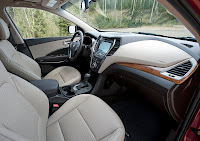
Both Santa Fe models feature the same flowing interior look, designed for passenger functionality and comfort. From the heated rear seats and available eight-way power driver seat, to a standard 40:20:40 folding rear seat back, both boast flexibility and a pleasant cabin for all. Also new for 2013 - and standard on all Santa Fe models with cloth seating - is a YES Essentials seat fabric treatment that provides soil-resistant, anti-odor and anti-static properties for added longevity and livability. Special care and attention went into other interior details, such as an optional panoramic sunroof, which allows more natural light into the cabin, and premium window switch trim. Available on 2.4-liter models and standard on Turbo models, is a push-button starter with proximity key and an electrochromatic gauge cluster color LCD screen. A heated steering wheel and sliding second row seats are optional first-class touches on Hyundai Santa Fe Sport. The heated steering wheel is also optional on the LWB Santa Fe.

The three-row Santa Fe increases second-row legroom by 1.9 inches and cargo capacity 5.6 cubic feet and houses second-row HVAC controls and vents to increase family comfort, while also offering a standard 50:50 split folding third-row bench seat with 31.5 inches of legroom.

CHOICE OF THREE POWERFUL, FUEL EFFICIENT ENGINES
Hyundai Santa Fe Sport buyers have the choice of a 2.4-liter Gasoline Direct Engine (GDI) engine or a turbocharged 2.0-liter GDI engine. Both engines have been well tested in the Hyundai Sonata and provide more than enough power for city or highway driving and have the ability to tow up to 3,500 pounds. With 190 horsepower and 181 lb-ft of torque, Hyundai Santa Fe Sport 2.4 still manages outstanding fuel economy of 22 city and 33 highway (EPA estimated). This powertrain truly combines power and fuel efficiency with ined driving dynamics. The higher output 2.0-liter turbocharged engine found under the hood of Hyundai Santa Fe Sport 2.0T increases horsepower to 264, while also delivering excellent fuel economy. The LWB Santa Fe is powered by the highly acclaimed 3.3-liter GDI V6 engine, which is also found in the Hyundai Azera.

THETA II GDI 2.4-LITER ENGINE
The Theta II GDI 2.4-liter four-cylinder engine with a GDI fuel delivery system contributes to improved fuel efficiency and lower emissions in Hyundai Santa Fe Sport. This shorter, more direct path of fuel delivery, allows for greater control of the fuel mixture at the optimum moment, thus improving efficiency. The fuel is injected by a camshaft-driven, high pressure pump that operates at pressures up to 2,175 psi. Direct injection also utilizes a higher-than-normal 11.3 compression ratio for increased power. When compared to naturally-aspirated engines, this power plant delivers best-in-class four-cylinder horsepower, best-in-class torque and best-in-class power-to-weight ratio. The high-tech, all-aluminum, 16-valve engine also features Dual Continuously Variable Valve Timing (DCVVT) and a Variable Induction System (VIS) for better engine breathing.

2.0-LITER THETA II TURBOCHARGED ENGINE
The new Santa Fe Sport 2.0T is the first Hyundai crossover to have both GDI technology and a turbocharger. This option provides more horsepower than many of the V6 competitors, yet delivers gas mileage similar to competitors four-cylinder models.

The 2.0-liter turbocharged GDI four-cylinder engine in the 2013 Santa Fe Sport 2.0T produces 264 horsepower and 269 lb-ft of torque with regular fuel. Hyundais 2.0-liter Theta II turbocharged engine features a twin-scroll turbocharger that when combined with the GDI system, results in instantaneous power delivery. The Ford Edge, like the Hyundai Santa Fe Sport 2.0T, uses a turbocharged GDI four-cylinder engine. However, the Hyundai Santa Fe Sport 2.0T has upped the ante with 24 more horsepower, a better power-to-weight ratio and higher fuel economy numbers.

Twin-scroll turbocharger designs have two exhaust gas inlets that are divided by split walls inside the turbine housing with both gas passages controlled by a waste-gate. A twin-scroll turbo recovers even more energy from the exhaust than a single-scroll turbocharger, thanks to a divided manifold. The twin-scroll design separates the cylinders whose exhaust gas pulses interfere with each other, resulting in improved pressure distribution in the exhaust ports and a more efficient delivery of exhaust gas energy to the turbochargers turbine.

For example, at the start of the intake stroke of cylinder one and when both the intake and exhaust valves are open (valve overlap period), cylinder three already begins its exhaust stroke with an open exhaust valve. If the exhaust passages of cylinder one and three were connected, the exhaust gas pulse from cylinder three would increase the back pressure of cylinder one - reducing the induction of fresh air and increasing the amount of hot residual gases inside the cylinder. However, with the twin-scroll turbocharger setup, this interference is minimized. The result of this superior scavenging effect from a twin-scroll design leads to several advantages over the traditional, single-scroll turbocharging systems:
  •     Better pressure distribution in the exhaust ports
  •     More efficient delivery of exhaust gas energy to the turbochargers turbine
  •     Greater valve overlap for improved quality/quantity of air charge entering each cylinder
  •     Ensures each cylinder is packed with a denser and purer air charge
  •     Improved combustion efficiency
  •     Low engine-speed efficiency
  •     Kinetic exhaust gas energy is not wasted or trapped
  •     Cooler cylinder temperatures
  •     Lower exhaust temperatures
  •     Leaner air/fuel ratio

The Hyundai Santa Fe Sport 2.0Ts twin-scroll turbo has superior handling of exhaust gas separation at the turbine, leading to improved low-end torque and faster transient torque response.

Two key features of Hyundais twin-scroll turbocharger setup are as follows:
  • The stainless steel exhaust manifold and the twin-scroll turbine housing are cast in a patent-pending one-piece design
  • The waste-gate for the turbocharger uses a motor-driven electrical controller instead of being mechanically controlled

Thanks to the integrated stainless-steel turbine housing with exhaust manifold, not only is the weight and cost of the casting dramatically reduced, but the durability of the turbine housing also improves. In addition, heat energy recovery and turbo efficiency significantly improve based on the fact that a traditional two-piece design effectively insulates some of the heat energy at the joint/gasket area.

By adapting the motor-driven electrical waste-gate, the boost pressure is precisely controlled. The back pressure is reduced when turbo boost is not necessary by opening the waste-gate, which improves fuel efficiency. During cold starts, the waste-gate remains open, which results in faster catalyst light-off for reduced exhaust emissions.

Direct injection also utilizes a 9.5 compression ratio in this engine, while achieving a best-in-class 132 horsepower-per-liter.

LAMBDA II 3.3-LITER GDI V6 ENGINE
Shoppers looking for a V6 engine will find that the long wheelbase Santa Fe suits their needs in terms of drivability and fuel economy. The Santa Fes Lambda II 3.3-liter GDI also has a high-pressure direct injection system (over 2,200 psi), which dramatically increases power and torque, while reducing fuel consumption and emissions. This system eliminates the need for a large displacement V6 engine and increases the compression ratio for greater thermal efficiency and output. Santa Fes V6 is perfect for towing small boats or weekend toys.

SIX-SPEED AUTsayaATIC TRANSMISSION
All the engines are mated to Hyundais six-speed automatic transmission with SHIFTRONIC® manual control. This transmission offers smooth shifts and a wide ratio spread that suits the engines characteristics. An automatic transmission warmer is included to keep the transmission oil at its optimal temperature, which improves real-world fuel economy.

All models have an Active ECO System that modifies engine and transmission control to smooth out throttle response and increase real-world fuel economy.

DO ANYTHING CAPABILITY WITH ACTIVE CORNERING CONTROL AWD
Santa Fe customers will feel the benefits of the optional Active Cornering Control All-Wheel-Drive (ACC AWD) system that cooperatively controls engine torque and braking in conjunction with the Vehicle Stability Management System. This system can anticipate traction requirements and deliver additional stability through braking via continuous monitoring of driving conditions compared with other AWD systems, which can only react to conditions after they occur. All AWD Santa Fes access an intelligent control unit that continuously analyzes data from the vehicle controller, and through a multi-clutch plate distributes torque to any single wheel at a time. The coupling system is fully controllable via an electro-hydraulic actuation system. Braking force can also be sent to any single wheel at a time via the software. These processes are known as torque vectoring and torque braking. All this analysis is completely transparent to the driver.

Drivers of the ACC AWD Santa Fe realize the following advantages:
    Improved lateral stability while cornering
    Removal of unintended over- and under-steer by reducing unwanted traction to the front and rear axle
    High thermal capacity, which helps prevent overheating during hill climbs and trailer towing

In addition, greater efficiency is achieved through the intelligent control electronics that provide the torque needed for enhanced traction in a variety of driving situations. As a result, lower fuel consumption and reduced emissions are achieved. The electronic components are also optimally sized for minimal energy usage. This intelligent system allows for even more driver control.

The 2013 Santa Fe models feature Hyundais Hillstart Assist Control (HAC) and Downhill Brake Control (DBC) to maximize control on steep hills. HAC minimizes rolling backwards on steep ascents while DBC helps the driver maintain vehicle control and speed on steep downhill descents. By selecting the DBC switch, the Hydro-Electronic Control unit manages the wheel speed sensors, steering angle sensor and acceleration sensor to maintain control and speed on steep declines without having to use the brake.

FUN-TO-DRIVE CUV DRIVING DYNAMICS
For enhanced ride performance, Santa Fe employs a compact and light MacPherson strut front suspension and a fully independent in-wheel multi-link rear suspension for improved cabin volume and ride quality. Hyundai Santa Fe Sport rides on 17-inch wheels and P235/65 R17 tires. Hyundai Santa Fe Sport 2.0T sits on 19-inch wheels with P235/55R19 lower profile tires. The front suspension has a 26.5 mm hollow stabilizer bar to save weight. The rear suspension uses a 21 mm solid stabilizer bar in the front wheel drive and 19 mm solid stabilizer bar in all-wheel drive models. The larger Santa Fe sits on 18- or 19-inch wheels.

Behind the wheel, drivers benefit from Hyundais all-new Driver Selectable Steering Mode (DSSM), with three operating modes - Comfort, Normal and Sport. This innovative system allows drivers to adapt Santa Fes steering characteristics to varying driving perences and road conditions. Comfort mode is ideal for city and parking environments, offering the greatest ease of steering with a ~10 percent decrease in steering effort from Normal mode. Normal mode is ideal for a mix of driving conditions. Meanwhile, Sport Mode is optimized for higher-speed freeways or winding roads and increases steering effort by ~10 percent from Normal mode. The DSSM not only adjusts power assistance levels in each mode, but also adjusts on-center build-up feel and steering build-up curves throughout the steering range, for a very natural and progressive feel. Steering damping characteristics, active return and friction levels have also been optimized in the new Santa Fe. Even more impressive is the fact that Hyundai engineers have successfully tuned Hyundai Santa Fe Sports class-leading 35.76 ft. turning circle for enhanced maneuverability. The LWB Santa Fes turning circle is 36.68 ft.

SANTA FE CABIN SPACE ADVANTAGE
The sleek design of Santa Fe, combined with Hyundais expertise in interior packaging, delivers a great presence on the road while improving functionality and convenience. The spacious cabin has more shoulder room than the previous generation and the Toyota RAV4 and Ford Edge. The three-row, seven-passenger Santa Fe also has more second row leg room than Nissan Murano, Toyota Highlander and the full-size Chevrolet Traverse. Seating utility is also improved due to a standard 40:20:40 folding rear seat back. This seat back is perfect for seating five passengers comfortably or accommodating four passengers, plus long items like skis, golf clubs, snowboards or surfboards. Fold down two seats to seat three people and hold larger packages or fold all rear seats to maximize cargo space. Customers will also discover Hyundai Santa Fe Sport has more cargo volume than Chevrolet Equinox and Ford Edge.

The LWB Santa Fe models come standard with three-row seating with standard second row bench seats (7-passenger) or optional second row captains chairs (6-passenger). The LWB Santa Fe also features a power liftgate for added convenience.

Santa Fe includes a number of convenient, standard stowage and storage features, including an overhead console sunglass holder, two front and two rear seat cupholders, door bottle holders, cooled glovebox, enlarged central storage console, front storage bin, front seat- back pockets and an innovative cargo under tray and floor board storage. The Hyundai Santa Fe Sport also features sliding and reclining second row seats.

Dual-zone climate controls ensure a comfortable environment for all occupants during long journeys. The dual-zone climate controls also incorporate an automatic defogging system, which detects humidity levels using a sensor and removes it from the windshield. Another premium feature is a CleanAir Ionizer that automatically cleans the air when the heater or air conditioner is running.

OVERALL DIMENSIONS
Hyundai Santa Fe Sport rides on a 106.3-inch wheelbase, with an overall length of 184.6 inches, height of 66.1 inches and width of 74.0 inches. The larger Santa Fe rides on a 110.2-inch wheelbase, which is 3.9 inches longer than the Hyundai Santa Fe Sports wheelbase. Its overall length is 193.1 inches compared with Hyundai Santa Fe Sports length of 184.6 inches. The 74.2-inch width is slightly wider than Hyundai Santa Fe Sport. The LWB Santa Fes overall height is 66.5 inches, which is 0.4 inches higher than Santa Fe Sport.

Ultimately, the long wheelbase for both models allows for compact crossover efficiency with mid-size crossover comfort. An example of this is found in the long second row seat track, delivering more second row legroom. The three-row Santa Fes cargo volume is 41.0 cubic feet with the third row seats folded.

IMPROVED RIGIDITY AND ULTRA-HIGH STRENGTH TENSILE STEEL
The all-new architecture incorporates a new design that increases high tensile steel application ratio to 37.7 percent (up from 7.8% on previous model) to not only improve torsional rigidity by 16 percent, but also improve vehicle weight and collision energy management. High-strength steel also allows the suspension to work optimally and reduce weight. In addition, anti-corrosion steel was applied to 70 percent of outer frame and floor structure.

New hot stamping and roll forming methods have also been applied to impact members, which provide added strength, reduces the number of body parts and makes the architecture lighter. The amount of structural adhesives has also been increased significantly for improved body rigidity, crashworthiness and durability.

WORLD-CLASS WEIGHT EFFICIENCY
World-class weight efficiency is an essential part of all Hyundai models and the new Santa Fe models hit their target. The new two-row, five-passenger 2013 Santa Fe Sport 2.4L FWD sheds a remarkable 266 pounds compared to the previous generation 2012 Santa Fe four-cylinder, while the Hyundai Santa Fe Sport 2.0T cuts a whopping 333 pounds when compared to the 2012 Santa Fe V6 FWD it replaces. These reductions are the largest weight losses from generation to generation for any vehicle in Hyundai Motor Companys history, and demonstrate a key enabler of Hyundais industry-leading fuel efficiency status.

The Hyundai Santa Fe Sport 2.4L FWD is also 318 pounds lighter than the Chevrolet Equinox and 56 pounds less than the segment-below (much smaller) Ford Escape. Even compared to premium brand vehicles like the 2012 Audi Q5 2.0 TFSI Quattro, which uses significant amounts of aluminum and magnesium in its architecture for weight savings, the 2013 Hyundai Santa Fe Sport 2.0T AWD tips the scales 384 pounds lighter. Taking weight out of vehicles pays dividends in fuel economy and performance. This priority on weight efficiency allows Santa Fe deliver carlike handling, outstanding acceleration and fuel efficiency. Curb weight for a FWD three-row Santa Fe is 3,869 pounds, with AWD models weighing 4,012 pounds.

NEW ADVANCED STANDARD SAFETY TECHNOLOGIES: PART OF HYUNDAIS ASSURANCE CsayaMITMENT
All FWD models have a standard Vehicle Stability Management (VSM) system, which optimally manages Electronic Stability Control (ESC) and the Motor-Driven electric Power Steering (MDPS). VSM works to control two effects. The first is when a driver accelerates or brakes on a split-mu surface (slippery on one side, dry pavement on the other) and the vehicle wants to pull in one direction. VSM detects this condition and sends a signal to the MDPS to apply steering assist. VSM counters the pull and automatically provides eight Newton meters of counter-steering. VSM reacts the same way during sudden lane changes or fast cornering. AWD drive models integrate torque and brake vectoring.

Santa Fe features seven airbags, including drivers knee airbag and side curtain airbags with rollover sensors. When the sensors detect a potential rollover, the control module triggers the head-curtain side airbags and safety belt pre-tensioners to help protect passengers against serious injury.

Santa Fe also features a state-of-the-art braking package. The package includes four-wheel disc brakes (12.6 inch front and 11.9 inch rear), an Anti-Lock Braking System (ABS) including Brake Assist providing maximum braking force when a panic stop is detected, and Electronic Brake-force Distribution (EBD) to automatically adjust the braking force to front and rear axles based on vehicle loading conditions. Additionally, Santa Fe offers impressive passive safety features including a Lower Anchors and Tethers for Children (LATCH) system for childrens seats and three-point seatbelts for all positions.

THIRD-GENERATION NAVIGATION AND AUDIO TECHNOLOGY
All Santa Fe models offer an optional multifunction eight-inch touch-screen display with navigation. This third-generation display features a simpler user interface, enhanced voice recognition commands and improved navigation screens. The system is more intuitive to use for commonly used tasks. Simple pop up messages now appear to help pair a phone. The voice recognition software understands street addresses and cities all in one sentence. The route screens display speed limits and details the next three maneuvers. One or two button pushes now complete most functions.

HD Radio technology is also integrated into all Santa Fe displays. An HD Radio icon on the display appears next to the channel frequency to notify the user this station is broadcasting in HD.

All models are available with four audio systems. Standard is an AM/FM/Satellite Radio/CD/MP3 audio system with six-speakers and iPod®/USB/auxiliary input jacks and wireless audio streaming. The upgrade audio system boasts a 4.3-inch full color LCD touchscreen with HD Radio technology and rear view camera. The third system consists of the Gen 3.0 Navigation unit and rearview camera paired with either a Dimension 10-speaker premium audio system or the Infinity 550-watt, Logic 7 audio system with 12 speakers, including an eight-inch subwoofer. A SiriusXM Satellite Radio interface is integrated into each head unit and features channel logos and SiriusXM Data services. A Bluetooth hands-free phone system with voice recognition, address book download and audio streaming is also standard. Blue Link™ turn-by-turn navigation is standard on all Santa Fe models.

Sunday, January 19, 2014

2012 KIA K9 Underpins the 2012 Hyundai Genesis

2012 Kia K9 is one of the latest Version of 2012 Kia. The 2012 Kia K9 is latest Kia Motors. Which 2012 Kia K9 is a larger? Which 2012 Kia more luxurious sedan named 2012 Kia K9. The 2012 Kia K9 is early sketches of officers were postponed and 2012 Kia K9 will debut in the Korean market first.

2012 Kia K9 arrives in the United States and 2012 Kia K9 which next arrive in Europe. 2012 Kia K9 is nice to see what the stiff of this car. 2012 Kia K9 looks like and it seems that 2012 Kia K9 is actually focusing on production. The 2012 Kia K9 has some slightly higher end models. It will complement 2012 Kia K9 lineup, adding a higher-priced, which 2012 Kia K9 is a high-status model at the top.

The 2012 Kia K9 has complete known plans to develop a Genesis sister car, code named CH. This 2012 Kia K9 sedan will be riding on the same chassis. Which 2012 Kia K9 underpins the Hyundai Genesis sedan while powertrains should be fairly similar to what is found in the 2012 Hyundai Genesis sedan? The 2012 Kia K9 will be a rear-drive sedan. Which 2012 Kia K9 has offered with V-6 engines, but 2012 Kia K9 is not the Tau V-8 and probably 2012 Kia K9 is not a four-cylinder engine.

Wednesday, December 25, 2013

2012 Hyundai Elantra Review

In opinions of the 2012 Hyundai Sonata, the same concept is recurring over and over again: value. The vehicle media says that the 2012 Hyundai Sonata gives customers a lot of conventional functions, like Wireless and USB feedback, internal room and design for the cash. Its class-leading gas mileage statistics don’t harm its popularity, either.

Overall, reviewers say the new Sonata does many things well. Vehicle Journal says, "The new Sonata is at or near the top of its hyper-competitive category in a wide range of groups - some you might anticipate (low price, gas mileage, light weight) and some you might not (power, twisting, internal space, and driving dynamics).” The 2012 Hyundai Sonata’s design shines among calm family cars. It’s the best choice for young individuals, family members or empty-nesters, and conventional functions like Bluetooth, satellite tv stations and a USB relationship returning up its value-oriented popularity.

If a six-cylinder engine is on your must-have record, you are out of fortune. The 2012 Sonata is only provided with four- and turbocharged four-cylinder applications. However, reviewers say both applications offer enough energy for the normal car owner. Additionally, the Sonata’s amazing gas mileage scores may make you consider the turbocompresseur four-cylinder, which is just as highly effective as aggressive V6 applications, instead of a V6.

Test individuals like the fashionable, modern internal and huge returning seat and footwear. Their only gripe is with its towel seats. Testers say they are not as nice as towel seats from other midsize cars and recommend the optionally available set seats.

Hyundai was enjoying catch-up for years to competition like  Toyota, Honda and Nissan. Now, it’s those car manufacturers who are catching-up to Hyundai’s design and value in the affordable midsize car section. If you want a good-looking car that has lots of functions for the cash, the 2012 Sonata should be on your narrow your search. 2012 Hyundai Elantra Review.

Monday, December 23, 2013

Hyundai Elantra GT Beautiful Good And Affordable

Niche in the small family general public, the arrival of the Hyundai Elantra GT 2013 represents the end of the reign of other manufacturers. Indeed, the Korean manufacturer began to take wing in the hottest category on the market and the need for renewal was felt among the public.
The Hyundai Elantra GT 2013 displays a flamboyant design in addition to benefiting from the grille which marks the entry of Hyundai into a whole new generation of automobiles. Its interior is both comfortable, luxurious and modern. In addition, its small four-cylinder 1.8-liter engine is among the most economical in its class.
The Hyundai Elantra GT 2013 is available in six versions – GL Manual, automatic GL, GLS, Manual, Automatic GLS, SE Tech is automatic and Automatic – whose base price ranges from $ 19,149 and $ 26,349, what makes it one of the most affordable cars in its class.
Hyundai Elantra GT 2013

Small mechanical largest economy Hyundai Elantra GT 2013

Despite its provocative look and sporty, the main objective of the Hyundai Elantra GT 2013 is fuel economy. It is for this reason that it has a small engine 4-cylinder 1.8-liter double overhead cam shafts. It has an output of 148 horsepower at 6500 rpm and 131 lb-ft of torque at 4700 rev / min.
The 4-cylinder engine of Hyundai Elantra GT 2013 is paired with a 6-speed manual transmission as standard. An automatic transmission equipped with the technology Shiftronic is optional. Regarding fuel consumption, Hyundai’s newcomer displays an average of 7.3 liters per 100 kilometers in the city and 5.0 liters per 100 kilometers, enough to make green with envy hybrids.
Hyundai Elantra GT 2013

A report quality / price Hyundai Elantra GT 2013

The Hyundai Elantra GT 2013 is perhaps not a luxury car, but the interior shows him otherwise.Refrigerated glove box, USB / iPod / Auxiliary, High resolution touch screen, leather seats, it lacks nothing.

Family and security

Since this is a car designed for the family, the Hyundai Elantra GT 2013 should provide a maximum cargo space while maintaining the safety aspect. It is for this reason that it has among other seven airbags and an occupant classification system, a first in the category. In addition, she is entitled to a management system stability highly sophisticated.
Hyundai Elantra GT 2013

Appeal to style

A few years ago, when the Korean manufacturer launched a new model on the market, was a total failure even before it is en route to dealers. Now, each new creation Hyundai displays a design and style that pleases.
The Hyundai Elantra GT 2013 is part of a new mid-class car family sedan mid-and I assume it will be the queen. Fuel efficiency, style successful performance ensured difficult not to find his characteristics in the new darling of the Korean manufacturer.

Hyundai Elantra GT 2013 News  


Hyundai Elantra GT 2013: Beautiful, Good And Affordable

Monday, December 16, 2013

Fuel Culture Hyundai Genesis Coupe Turbo Hot On Your Heels

What do you get when a supplier of tuning products allows complete freedom in the design of a normal coupe? Right, an awesome level with the right fire under. This happened between FuelCulture and Hyundai. Result: the Hyundai Genesis Coupe Turbo Concept with robust 320 hp and a maximum torque of 328 Nm under the hood.


320 hp is a 2.0-liter four-cylinder engine is not usually expected, but this has usually offer the Hyundai Genesis Coupe Turbo only respectable 277 hp. But if to be pimped, then boasted instead spilled. Since 43 hp more directly be fetched from the box. To keep the extra power under control, built the makers a “boost controller” and a new “ARK DT-S” exhaust system in order to ensure a better response during switching and reduce the top speeds the boost pressure. The improved pulling power to the inmates literally squeeze the smile on your face.


Hyundai


If up until this point has not yet been possible to twist the head will not turn away his eyes from the optics, for the Hyundai Genesis Coupe Turbo Concept of Fuel Culture comes up with a beefy front. The rich dark red color “Candy Apple” exudes an air of sin. The new hexagonal front grille seems to grin smugly, as if he knew exactly what he looks like.


New, deeply drawn, dynamic bumper, striking side skirts and a rear apron with integrated diffuser stately pull the car by 50 millimeters apart. In the new 19-inch wheels made by Rotiform that support the aggressive sporty look, attracted the makers of “Continental Extreme Contact DW” tires (front with 225/35 and rear 265/30).


Hyundai


Changes in the interior reduced Fuel Culture to a minimum. The comfortable Alcantara sport seats, the rear bench and the insides of the doors are color matched and stitched diamond pattern. If that’s not enough, you can also still turn up a sonorous sound system from Rockford Fosgate. At least here, not only have all heads turned, there are also a lot of stalk eyes. Guaranteed!


Hyundai Genesis Coupe Turbo


Fuel Culture Hyundai Genesis Coupe Turbo: Hot On Your Heels

Saturday, December 14, 2013

Hyundai i30cw Review

Hyundai i30cw takes the 1.6 CRDi Classic Business
Hyundai has revised the specially launched for commercial customers combined i30cw 1.6 CRDi Classic Business. From outside, the new edition of the sharpened front with enlarged air inlet, and the arrow-shaped chrome frame that surrounds the Hyundai logo, recognizable. A new rear apron and side skirts also refer to the i30cw the model year 2011. Been upgraded, the business model is now also with standard fog lamps.

Start-stop system
The business-model fitted as standard start-stop system and a new gear shift indicator provide a total consumption of both levels of the common-rail diesel engine (66 kW and 85 kW) from 4.6 liters per hundred kilometers (CO2: 122 g / km ).

Equipment
The i30cw 1.6 CRDi Classic Business is based on the basic features of the i30cw, which has been equipped with air conditioning, cruise control, ESP, radio, or so useful details, such as a coolable glove compartment and additional connections for USB, i-Pod and AUX. In addition, he was equipped with a wireless remote control for central locking, an adjustable lumbar support on drivers seat, heated and electrically adjustable exterior mirrors in body color, and seat pockets on the back of the front seats. The metallic paint is included.

Vehicle Warranty
Hyundai is the i30 series five instead of three years full vehicle warranty with unlimited mileage (except for taxi and hired vehicles - three-year warranty and limited to 100 000 km), including the painting back up the fleet managers a worry-free use of their Hyundai fleet.

Saturday, December 7, 2013

Review 3 in 1 l Hyundai Elantra Coupe Elantra GT and Veloster Turbo

Hyundai prides itself on efficiency, and this feature is now extended excerpts from media Car car manufacturer. Instead of showing one or two new models during a recent driving event, Hyundai has full power and gave us a trio of 2013 cars in just a matter of days.

All three models - the Coupe Elantra, Elantra GT, and Veloster Turbo - are themselves effective in terms of fuel economy, power and weight saving design, but they also stand out for their uniqueness by relative to one another and in a growing range of Hyundai. Heres what we found during our time behind the wheel.

2013 Hyundai Elantra Coupe:
Since its redesign in 2011, the Elantra has become a formidable competitor in the compact segment, cleverly go toe to toe with pillars such as the Honda Civic, Toyota Corolla and Ford Focus. The Elantra has been adopted by a wide variety of buyers looking for low fuel consumption, good-looking, low-cost sedan. If you want a coupe version, however, you were out of luck.

Which eventually changes for the 2013 model year with the introduction of the Coupe Elantra. With this stylish two door version of the Elantra, Hyundai hopes to broaden its base of buyers when the car reaches dealerships in the coming weeks with a starting price of $ 18,220, including destination.

Like his brother sedan, Elantra coupe is powered by a 1.8 liter 4-cylinder that makes 148 horsepower. The engine is another issue that is equally important to todays buyers: 40. As the Elantra sedan, the coupe is estimated to return 40 mpg on the road (in this case with a 6-speed manual transmission, 6-speed automatic get up to 39 mpg). During our test of the 2013 Elantra Coupe on countless miles of winding mountain roads and highways in the San Diego area, the focus of the car on the effectiveness was evident. The engine power is sufficient enough to satisfy most drivers, but not those who want a high speed measurement with their sporty coupe. And unlike the Honda Civic Coupe and Kia Forte Koup, only the engine will be offered in 2013 Hyundai Elantra Coupe. Steering feel was a bit disappointing, with only a vague idea of ​​what was happening.

On a more positive note, the roomy 5 seater Coupe Elantra was quieter than expected, and the suspension was not as hard as the previous Hyundai models. The finish is good in our test model SE, which flaunts material soft to the touch and comfortable front seats have heating standard.

The verdict: The new Hyundai Elantra Coupe is not likely to win many drag races, but it is interesting in many other ways, not the least of which his eyes are good value and fuel economy figures .

2013 Hyundai Elantra GT
Like the Coupe, the GT is a new version of the Elantra. The Elantra GT 2013 is a compact five-door hatchback that essentially replaces the Elantra Touring. A look at the GT vs tourism, and it is easy to see why Hyundai decided to bring this European hatch to take the place of the Elantra Touring quite unsightly. "We thought this car just looked great, and there was some overlap (the Elantra Touring) between Tucson," said Hyundai Motor America President and CEO John Krafcik. The GT will be available in the coming weeks with a starting price of $ 19,170.

The GT looks, convenience and fuel economy (up to 39 mpg) nailed, but a pleasant surprise is also a lot of fun to drive. Although it uses the same 148-horsepower, 1.8-liter Elantra models other than the GT has a trick up its sleeve that makes the miles roll on much more attractive: a 3-mode selectable by the driver management function. With the touch of a button, you can choose between Comfort, Normal, Sport and settings to take the lead feel more or less firm. Although negligible difference felt between the first two, the Sport setting makes the GT in a different car, which skillfully carved mountain roads with aplomb. If your desires in a car lean toward the pragmatic, the GT has covered these bases, too, with a list of standard features that includes a cooled glove box, fold-flat rear seat and hidden storage.

The verdict: Combined with a forward shift 6-speed automatic transmission, the versatile and fun to drive GT quickly became our favorite Elantra.

2013 Hyundai Veloster Turbo
The Veloster. Just the name sounds aggressive. But when one of Hyundai hatchback debuted in 2012, driving enthusiasts found it lacking in the department of power. Well designed and efficient, yes, but Hyundai youth motor 4 places with the door just looked weird third part of a sports car.

This will change when the Veloster Turbo will go on sale later this summer. To make the Veloster kind of fast car many envy, Hyundai has blessed this spicy version with a twin-scroll turbocharger. Although the small size of the engine 4-cylinder remains the same as in the regular Veloster - 1.6 liters - power figures have improved significantly: 201 hp and 195 lb-ft of torque for turbo, against figures 138 and 132, respectively, for the naturally aspirated Veloster.

On paper, the numbers look good. On the road, they are even better. It is as if the Veloster many of us wanted in the first place. 2013 Veloster Turbo is not fast supercar by any means, but it is much better suited for screwing a red light or passing on the highway. The time the turbo was not visible, even if it is a car with four-wheel drive, and it was couple. The suspension has not been modified, but even with the added power the Veloster Turbo remained composed of a variety of routes and even autocross course.

And the Veloster Turbo is fuel efficient. The car loses only 2 mpg against non-turbo, at least in form 6-speed manual transmission. With the gearshift lever short stroke, a Veloster Turbo collect up to 38 mpg on the highway, those with a 6-speed automatic transmission still earn a commendable 34 mpg.

The verdict: With a starting price of $ 22,725 - $ 4,500 more than the base model, but with more standard features like leather seats, heated front seats and a 450-watt audio system - the Veloster Turbo is one we choose in a heartbeat.

Thursday, December 5, 2013

Revamped Hyundai Models Coming in and 2014


The Hyundai Sonata will be updated for 2014, and a redesigned Hyundai Genesis sedan will debut in 2013, Hyundai CEO Kim Choong-ho told Reuters Wednesday. The Sonata debuted in the U.S. in 1989, and the current generation was redesigned in 2011, while the Genesis sedan debuted in the U.S. as a 2009 model and was updated for 2012.

The Sonata is Hyundai’s best-selling model in the U.S., making up 35 percent of all Hyundai U.S. sales, writes Kicking Tires. After the redesigned model went on sale last year, this midsize sedan impressed reviewers with its dramatic styling, above-average fuel economy and value for the money.

A significant revamp after the current generation’s four years on the market is about standard for the industry, and according to Automobile Magazine, the Sonata’s refresh will help it compete better with newer rivals. The Volkswagen Passat and Toyota Camry are all-new for 2012, a new Ford Fusion will hit dealerships as a 2013 model and a redesigned 2013 Chevrolet Malibu is already on sale, with the full lineup coming later this year. The next generation Nissan Altima will be unveiled next month at the New York Auto Show, and a new Honda Accord and Mazda6 are expected to be on their way in the near future.

Hyundai hasn’t announced the changes it’s planning to make on either model, but Autoblog suspects that the updated Sonata will debut in the U.S. in 2013 as a 2015 model. Car and Driver predicts that the new Genesis will offer optional all-wheel drive, and that it will arrive in 2013 as a 2014 model.

Hyundai is having a hard time keeping up with U.S. demand for its vehicles. Between now and 2014, Hyundai is introducing new versions of five vehicles: the Genesis Coupe, Azera, Santa Fe, Sonata and Genesis sedan.

If you’re shopping for a new car in the near future, these updates likely won’t mean much to you right now. However, if you plan to buy in the next year or so, keep an eye out for more Hyundai news. Hyundai’s recent efforts, including the new Veloster and Elantra, have all met with critical acclaim, and publications like Left Lane News say to expect the same when the next Sonata and Genesis eventually hit the U.S.

Tuesday, December 3, 2013

2011 Hyundai Sonata Price of 28 000

2011 Hyundai Sonata is a stylish outline of a sport coupe assembles the functionality of sedan. The 2011 Hyundai Sonata foundation model will be obtainable as a standard is specified. Aspect, called a quality package that touch-screen navigation system, a sub-woofer and external amplifier is added ir.

The 2011 Hyundai Sonata is a 4-door, 5-passenger family sedan, available in 9 trims, ranging from the GLS Manual to the Hybrid. 2011 Hyundai Sonata is available at a price of not more than $28,000. Which they limited to your budget.

Before Production, the 2011 Hyundai Sonata GLS Manual is prepared with a standard 2.4-liter, I4, 198-horsepower engine that achieves 24-mpg in the city and 35-mpg on the freeway. A 6-speed manual transmission with overdrive is standard. The Hybrid is prepared with a standard 2.4-liter, I4, 166-horsepower, hybrid engine that achieves 35-mpg in the city and 40-mpg on the highway. A 6-speed automatic transmission with overdrive is standard. The 2011 Hyundai Sonata that covers pros and cons, accessible options, power trains and overall driving performance. The Stylish and modern, the all-new 2011 Hyundai Sonata gets up to 35 MPG.

Thursday, November 28, 2013

Review Hyundai Genesis Coupe

In case you havent noticed, Hyundai is a company that is not known these days for complacency. With new models being introduced at a furious pace, Hyundai is constantly evolving and improving their cars. You would expect that attention to be lavished upon the bread and butter Elantra and Sonata. And us enthusiasts are simply thankful Hyundai offers a rear-wheel drive 2+2 sports coupe at all, and wed even forgive Hyundai for not refreshing a high-profile but niche car. But thats not how Hyundai rolls.

The Garage reviewed a 2010 Hyundai Genesis Coupe and came away generally impressed. For 2013, Hyundai has revised the Genesis Coupe, and the results of some minor tweaking show a considerable improvement over what was already a fine performance car. The most obvious change from outside is the new nose treatment which gives the Genesis Coupe a far more serious look to it. The bolder design makes last years car look meek in comparison. The hood scoops also add some visual interest, but they are for decoration only. Apart from new taillamps, the Genesis Coupe is unchanged from before. Finished in Gran Premio Gray with handsome 19 wheels, our Genesis Coupe showed a level of sophistication not seen in the prior car.

Hyundai also spruced up the interior for 2013. Instead of idiot lights between the speedo and tach, the driver is greeted with a more contemporary LCD screen for vital information. The center console has also been improved, again offering a more contemporary appearance. A nice touch not seen on last years car is the introduction of three analog gauges offering oil pressure, torque meter or turbo boost. Not a big deal, but it does a lot to add sport coupe credibility. The rest of the Genesis Coupes interior is untouched, which isnt a bad thing. While I still find the location of the power window and mirror controls less than ideal, the ergonomics are otherwise excellent. Visibility remains very good for a sports coupe, and as before, I found the seats very comfortable. I loved the red and black interior color combination, reminding me of my friends old BMW 633CSi. Classic.

Hyundai did not simply give the Genesis Coupe a facelift and an interior upgrade. The engine room received much attention, not that anyone was complaining for lack of power. As before, Hyundai offers the Genesis Coupe with either a turbocharged four cylinder, or normally aspirated V-6. For 2013, the base Genesis Coupe is powered by a 2.0L turbocharged four rated at 274hp, a 30% boost in power over last years car. Our test car sported the V-6, a 3.8L direct injected powerplant generating 348hp, a full 42hp more than the 2012 V-6. Expect 0-60mph in the low 5-second range. The V-6 Genesis Coupe is one fast car, and the power delivery is so linear. The fact that the car produces one heck of a sinister exhaust note only sweetens the deal, and youll find yourself downshifting and blipping the throttle just to hear the fun.

If I had a complaint about the driving experience of the last Genesis Coupe, it was the shift linkage in the manual transmission. Thankfully, Hyundai heard the complaint, and for 2013 the six-speed manual is a dramatic improvement, and definitely helps make hustling the Genesis Coupe an even more enjoyable experience. Our test car was the R-Spec, meaning it has the firmest suspension and beefiest brakes offered. Even so, the car was very easy to live with, and perfectly comfortable over less than perfect roads. With summer tires, the Genesis stuck like glue to the pavement, and handling was exceptional. Its a very rewarding and easy car to drive quickly on your favorite back road.

A base Hyundai Genesis Coupe 2.0T starts at $24,250USD. If you can swing it, I strongly advise shelling out more for the V-6. Not that the four is slow, but the soundtrack and smooth power delivery is worth every penny. The V-6 Genesis Coupes are offered in R-Spec, Grand Touring and Track models. The R-Spec is the entry-level car, but you wouldnt know it. The R-Spec includes a front strut tower brace, 19 wheels with summer performance tires, Brembo brakes, Torsen limited slip differential, leather and cloth sport seats, six speaker stereo with XM satellite radio and Bluetooth. Including delivery, our Genesis Coupe R-Spec rang in at $29,625.

That represents one heck of a performance bargain. The improved Genesis Coupe has a lot going for it. More practical than a Nissan 370Z. More lively, nimble and involving than V-6 powered Camaros or Mustangs with a much better interior to boot. Hyundais dive into the world of rear wheel drive sport coupes was impressive, and three years later Hyundai has made small changes that have greatly improved the overall package. Well done.

Related posts:

  1. Hyundai to show new rear wheel drive coupe concept at LA auto show
  2. Review: 2010 Hyundai Genesis Coupe
  3. Driven: Hyundai Genesis Coupe 3.8 Grand Touring
  4. Review: 2012 Hyundai Genesis 5.0 R-Spec
  5. Rhys Millen attacks Pikes Peak with Hyundai Genesis Coupe


Wednesday, November 27, 2013

2012 Hyundai Equus Ultimate

Specification Modification Image Review 2012 Hyundai Equus Ultimate
The 2012 Hyundai Equus Ultimate is a reasonably executed flagship luxury sedan -- but should anyone care? Flagship luxury and sound financial sense just dont go together, and thats what makes the 2012 Hyundai Equus Ultimate so tough to review.

Pricewise, the $66,650 Equus Ultimate -- the more expensive of two trims -- competes with midsize luxury sedans like the Mercedes-Benz E550 and Infiniti M56, but no one is going to cross-shop those vehicles. That leaves the Equus fighting cars like the Lexus LS 460 and Mercedes-Benz S550 -- vehicles that, even in their old age, can stifle the 2012 Equus arguments for rational luxury on a price-independent level. 

 Interior refinement on the Equus is exactly what youd expect for a proper luxury flagship, though there are a few small omissions. We arent talking about big stuff here – little amenities like power lumbar adjustment for the front passenger seat, side bolster adjustments for the front chairs or a one-touch close feature for the sunroof, for example. Still, our Ultimate-spec testers cabin arrived positively lousy with bells and whistles – niceties like a heated steering wheel, heated and cooled seats all around, a refrigerator in the rear console, power sunshades and a rear entertainment system.

What separates the Ultimate from the base Equus is its rear seating configuration, ditching the three-passenger bench seat in favor of two chairs with a fixed center console. The rear passenger-side chair – the one weve named the "executive throne" – even has massage and recline functions. If you ever have the chance to sit in a four-passenger Equus, we highly recommend spending no less than five minutes exploring the features of the royalty seat. Be warned, though – even with the Equus longer wheelbase over the Genesis, those rear seats dont offer as much legroom as you might think.


Hyundai will continue to offer its unique ownership experience for 2012 Hyundai Equus customers, including tailored dealership showrooms, “Your Time, Your Place” at-home vehicle demonstrations, valet service appointments and an interactive owner’s manual for Apple iPad and Android tablet devices.

The sales and service experience for 2012 Hyundai Equus is unlike any other in the industry, with a focus on the customer’s time and convenience. Prospective buyers can participate in the “Your Time, Your Place” valet test drive program, where a specially trained Product Champion will deliver an Equus to their home or office for a personalized shopping experience.

2012 Hyundai Equus features the industry’s first interactive owner’s manual, providing a convenient and simpler way for owners to become familiar with the full capabilities of the vehicle.
When service is required, Equus owners can schedule their maintenance and service through a simple online scheduling system or from the interactive owner’s manual. An Equus owner can also choose to have their vehicle picked up at their home or business, with a complimentary loaner dropped off. Once service is completed, the owner again chooses the time and location for the vehicle to be delivered.
source:autos.aol.com,motortrend.com,autospectator.com